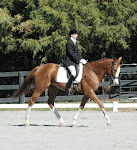
Farrier Arvin Reynolds answers:
When you start jumping a flat footed horse in a competitive way, especially out in the field where terrain can be rocky or otherwise unpredictable, shoes are a must to protect the soles. I would recommend full pads during show season or heavy training, for additional protection against bruising. Leather pads (as opposed to plastic) allow the hoof to breathe and reduces the potential for debilitating thrush build-up. Your farrier should inject a supportive material between the pad and the hoof to help keep dirt and debris from getting under the pad. I normally use Equipak CS.
Finally, you might consider asking your farrier to roll the toes of the shoes to facilitate break-over.
I'm not aware of any shoes marketed specifically for flat-footed horses at this time, however, the Rick Redding Roller Motion or "banana" shoe might be applicable here.
Good luck with your new horse!
Arvin Reynolds can be reached by phone at 703-895-4786 or email AGRShoeing@aol.com
Friday, April 4, 2008
Ask the Farrier: Shoes for Jumping a Flat-Footed Horse?


Saturday, March 15, 2008
Tips for Simpler Springtime Shedding

The days are getting longer and everything you own is covered in statically charged horse hair. It's almost Spring!
Here's a few tips for easier grooming and shedding during these hairy times:
- Make two passes with a long toothed rubber curry before using the shedding blade. The shedding blade will be able to get more hair if it's already loosened.
- Consider wearing a mask to cover your nose and mouth while shedding. You are a magnet for floating horse hair and when you're less busy wiping your face and groaning, you'll more likely to groom longer!
- When you're finished with the shedding blade, spray the whole horse down with a dry shampoo like Cowboy Magic Green Spot Remover. Then do a rub down with a rag with a heavy nap. The shampoo with help reduce the dust and dander you stirred up with all the currying and your horse will feel less itchy. If the coat still looks dull (as most do while shedding out), finish with a spray of coat shine (like Showsheen or Vetroline Shine, not on saddle area) and rub in again, then brush out with a soft dandy brush.
- When it's warm enough, bathing can be a good shedding exercise. When the horse is lathered with soap, curry with a soft rubber mitt to loosen dead hair, then spray off with the hardest spray setting your horse can tolerate comfortably. Happy Shedding!
Thursday, February 28, 2008
Horse Training Tips - Halting for Strength

Did you know one of the easiest strengthening exercises to do is as simple as halting? When done properly, working with halts can help your horse develop the muscles to carry himself in a lighter, more balanced frame under the rider. Here's a few tips to improve the quality of your halts:
- Minimize the Hand Aide. The more "help" you offer with the hand, the less likely the horse is to balance herself on her own. Let closing the hand be the last thing you do, and try to eliminate pulling back alltogether.
- Don't Rush the Halt - Abruptness is the enemy to a good halt. The horse should glide into stillness, not lurch. Try encouraging the horse to take a few smaller steps before halting, and visualize the hind legs taking one more step after the front legs have stopped.
- Make Sure Your Horse Accepts Your Legs. If you can't close your lower leg in without your horse leaping forward or tensing, you need to address this before halts can be productive. A really good halt starts with a steady closing leg (to gather the horse and keep his balance from shifting into your hand).
- Lift Against a Leaner: If your horse leans into the bit in the halt, stay back in the saddle and lift both hands by bending your arms at the elbow while closing the leg. When she backs off the bit, immediately lower your hands. Repeat many times.
- Repeat the mantra: Patience & Praise. Halts can take a long time to improve. Taking breaks by doing unrelated exercises in between the halting work will help ensure sure halts don't become a source of anxiety for your horse.
photo courtesy of Seven Oaks Farm
Sunday, February 24, 2008
The "Bad Horse" List
Here's a cute webpage, good for a laugh, from www.jerseyguy.com Haven't we all wished our horses would make such promises....
Here's few choice selections from the page:
I will not poop in my water tub.
I will not poop in my feeder!
I promise not to swish my tail while my human is cleaning my back feet. I also promise not to choose that particular time to fulfill my basic needs.
I will not totally ignore the noise of the lunge whip and do my own thing on the lunge.
I will listen to my human on the lunge rather than see what's interesting at the other end of the school.
When being ridden bareback, I won't try to see how high I can get my bucks.
To read the whole thing CLICK HERE
Saturday, February 23, 2008
Horse Help Hotline Introduced by Kentucky Horse Council

The hotline is available at 866/634-0030, and is the result of a horse industry emergency roundtable meeting held Jan. 23, 2008. Attendees--including a number of breed, veterinarian, rescue, and animal control groups--engaged in a lively and in-depth discussion of the current hay and unwanted horse situation in Kentucky. Solutions, problems, and difficulties addressing the growing
concerns were discussed. The new hotline was one of the tools proposed in this
meeting. The assistance provided through the hotline will be supported by
donations to the Save Our Horses (SOHO) Fund. Donations can be made to SOHO
online or via mail to: Kentucky Horse Council, 4063 Iron Works Parkway,
Suite 2, Lexington, KY 40511.
Friday, February 22, 2008
Ask the Farrier - Shoes Needed on a Flat Footed Horse?
Elaine from Raleigh, NC asks this question: "I recently purchased a 4 year old Thoroughbred/Percheron cross gelding who passed his pre-purchase with no problems, however, the vet commented that he has flat feet and I should put shoes on him before I work him so that his soles don't get sore. He has been in light ring-work before I purchased him. I plan to train him for eventing, and we will jumping little stuff in a few months. Is there a certain type of shoe for flat footed horses? Should he have pads? Thanks."
Thanks for your question Elaine! Look for the answer from certified farrier Arvin Reynolds to be posted here Wednesday morning, Feb 27th. Congratulations on your new purchase!
Thursday, February 21, 2008
The Bran Mash Controversy - Helpful or Harmful?
 It's only in the mid-thirties here in Virginia today for a high - the air is cold and dry, the ground in covered in snow and tomorrow we're expecting another small snow storm. I'm thinking bran mash! and, I think, so are the horses in the barn after spending a boring day munching dry hay. But there are the Bran Mash Downers out there, and I thought it would be a good day to highlight some arguments from both sides (for fun, let's call them the Bran Booers and the Bran Brigade).
their diet in fodder such as hay or grass. The addition of bran whether wet or
dry is not likely to be a benefit."